
The Day Everything Changed
They called the whole family in. You know, when they do that, what’s coming is going to change everything.

By Crystal Atlantis
This series is based on my personal lived experience and recollections, and taken from documentation, including formal complaints submitted at the time. Names of individual staff members have been omitted.
This is Article 3 of an ongoing series. If you haven’t read the previous articles yet, start from the beginning:
Article 1 — They Were Supposed to Care:

Article 2 — Calling It Out:
“Everything changed in that moment. I knew before they even said a word.”
The Room
They called us in for a meeting.
A large room. filled with medical equipment. The kind of room that feels serious before anyone has spoken.
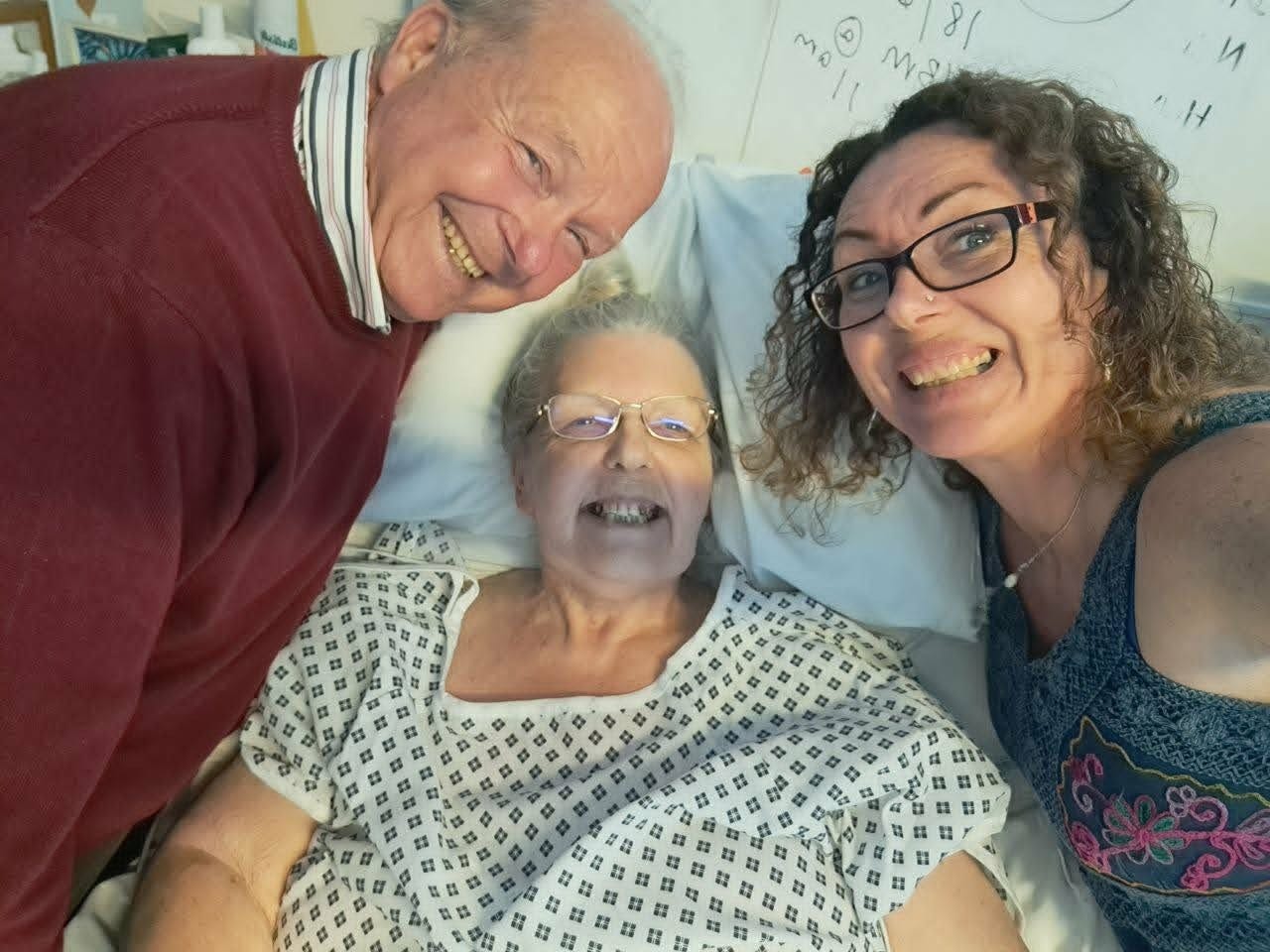
Me, Kerry, Dad.
And I remember the feeling that came over me the moment we sat down.
I already knew.
Mum was wheeled in on a bed.
There was something in the atmosphere. Something in the smell of the hospital. A gut feeling I couldn’t explain but couldn’t ignore.
I think I already knew it was cancer before they said the word.
What They Said
Lung cancer.
Metastasised into her spine.
The cancer had spread into the lower part of her spine and had fractured several vertebrae. It had caused narrowing and instability.
That was why she had been in so much pain.
That’s why she had been having excruciating spasms.
That was why walking had become impossible.
That was why every movement was agony.
This was the answer to everything we had been trying to understand for so long.
And it was the worst possible answer.
When the words came out of the doctor’s mouth…… “I’m really sorry you have cancer”.
It was as if everything stood still.
Time slowed down. The room felt different. Everything felt different.
Mum burst into tears and said:
Am I going to die?
The doctor said we need to do more tests to find out which type of cancer it is. We don’t know what type of cancer we’re dealing with yet.
We were all crying.
We each hugged her. I didn’t have the words. But I was there.
“Lung cancer. Metastasised into her spine. The cancer had fractured several vertebrae. This was the answer to everything. And it was the worst possible answer.”
The Oncology Doctor
In that first meeting, the oncology doctor was really kind.
He gave us time. He didn’t rush us. He explained things calmly and with care. He seemed to genuinely understand how overwhelming this was for our family.
In those early moments, I felt that he saw us. That he understood this wasn’t just a medical situation — it was a human one.
That mattered. That meant a great deal.
Because he seemed so approachable, I felt safe enough to phone him afterwards.
I’ll be honest — I lean strongly towards natural and holistic approaches. That’s who I am and how I work. Mum felt the same way. She preferred natural approaches. She had healing sessions with me. That was her choice. Her preference.
I’d done a great deal of research and spoken with people I trusted about natural and supportive therapies that could work alongside Mum’s treatment. And honestly, I do believe some of it helped.
At one stage, they had expected her to decline very quickly, but after a while, the staff were asking what we were doing and telling us to keep doing it because she was doing well.
I can’t scientifically prove what made the difference. But I believe the care, the therapies, the nutrition, the massages, the emotional support — all of it mattered. And I wasn’t willing to stand by and do nothing for someone I loved.
So I phoned him a few days later. I wanted to ask about natural alternatives — things I’d been researching — alongside whatever conventional treatment they were offering. I was asking from a place of love and desperation.
That phone call changed everything.
He became very authoritative. Hostile even. It wasn’t quite an argument, but it was difficult and uncomfortable. Oncology would not be supporting anything natural. That was that.
I understood they could only support treatments they considered medically appropriate. But the way that conversation changed left me feeling shut out rather than supported.
Surely a terminally ill woman should have the right to choose how she is cared for. Surely her preferences should matter.
And after that phone call, things shifted permanently.
Later, on the ward, the oncology team came to Mum’s bed. Three or four doctors. They pulled the curtains around.
He refused to acknowledge me.
Turned his back. Wouldn’t look at me. Wouldn’t engage with me at all.
I found that deeply upsetting.
I wasn’t being difficult. I wasn’t trying to cause problems. I was a daughter trying to help her mum in every way she could.
His approachability in that first meeting had made me feel safe enough to reach out.
And when I did, I was shut out completely.
At this point, Mum still trusted the hospital. That would change. But not yet.
The Choice Nobody Was Given
As things went on, the way information was delivered became more and more brutal.
Me and Kerry made a decision early on. We chose not to attend certain meetings. We didn’t want to know the graphic details. That was our choice. Our way of protecting ourselves whilst we focused on supporting Mum.
But Mum and Dad didn’t always get that choice.
Information was delivered to them whether they were ready for it or not. Graphic details. Difficult prognoses. Things that no one had asked to hear.
Mum didn’t want to know everything. We didn’t want her to have to know everything.
But it was enforced upon her.
And I want to ask — because I think it genuinely needs to be asked:
Shouldn’t a patient have the right to choose how much they’re told, and when?
Shouldn’t that be their choice?
Surely basic dignity includes the right to say — I’m not ready for that yet. I don’t want to know that today.
That choice was taken out of Mum’s hands.
And it shouldn’t have been.
Something We’d Noticed Before
There is something else that has stayed with me.
For quite a long time before all of this, Mum had a strange indentation on her back. A big scar-like mark. It looked almost like an old surgical scar — the skin pulled inward, oddly wrinkled.
Mum used to mention it herself. She’d say it looked as though she’d had an operation there, even though she hadn’t.
Looking back now, I sometimes wonder whether it was connected to the cancer underneath. Whether the tumour was somehow pulling the skin inward, reflecting changes happening deeper in the tissue.
I can’t know that for certain.
But it has stayed in my memory. And it feels significant.
Because if something visible like that was there for years and nobody ever properly investigated it, then that is yet another sign that was missed.
The Belt
As part of her treatment, they fitted a spinal belt — a back brace to support and stabilise her fractured spine.
In the beginning, when Mum was still mobile, it wasn’t such a problem. She could adjust it herself.
But when she became bedbound, everything changed.
The belt kept riding up — from her lower spine all the way to underneath her ribcage, right under her bust. And nobody would move it back down.
The carers hadn’t had the training. The district nurses refused. One of them actually threw his hands up at Kerry and said — I’m not touching that. Just like that. Hands in the air. Walking away.
The hospital wouldn’t deal with it either.
The only people who would touch it were two of the palliative nurses. Two people. Out of everyone involved in Mum’s care.
And when it was sitting up under her ribs, she couldn’t breathe properly. It was pressing on her lungs.
Mum already had lung cancer. She already had breathing difficulties. And now she had a belt pressing on her lungs that almost nobody would touch.
They had made such a big deal about her needing to wear it. In the beginning, it made sense. But as time went on it became less like protection and more like a noose. Ineffective. Causing harm. And nobody was willing to do anything about it.
She had that belt from June 2024 until she went into the hospice in April 2025. Ten months. Changed twice in all that time. It stank. It was unhygienic. Rotten.
And it was only on the day she went into Fairhaven’s Hospice — her very last day at home — that someone finally said:
Why is this on?
They took it off.
She could breathe.
She relaxed.
“Ten months of that belt riding up, pressing on her lungs. The hospice removed it in minutes.”
The Worst Day
I remember walking into town afterwards.
Me, Kerry, Dad.
We needed to buy Mum some nighties for her hospital stay.
And I just remember this overwhelming sense of disconnection. Everything felt surreal. Like I wasn’t quite in my body.
The world was just carrying on. People shopping. Cars going past. Nobody knew what had just happened. Just going about their day — which is fine, that’s life — but for us, our entire world had changed in that room. In that moment.
And nobody around us knew.
I didn’t want to upset Kerry and Dad. I didn’t want to make it about me. So I tried to hold it together. But the tears kept coming anyway — quietly, silently, just there at the edges of my eyes. That kind of crying where you’re trying not to cry but you can’t quite stop it either.
I know now that what I was experiencing was shock, dissociation, and a kind of soul loss. I know those things from the work I do. But when you’re in it, you don’t realise it. You’re just in this fog, trying to function, trying to keep going.
Throughout all of it — every hospital visit, every crisis, every battle with the system — I was trying to hold everything together.
As if I were spinning multiple plates all at once. Trying to keep them all up. And sometimes they’d crash down around me.
I’ll write about that more in a later article.
I thought: nothing is ever going to be the same again.
I was right.
What Came Next
After the diagnosis, Mum was placed on the NHS fast track pathway for end-of-life care, a system used when someone is believed to be rapidly deteriorating or approaching the end of life. Without our agreement.
But things did not unfold in the way they initially predicted.
A DNR — Do Not Resuscitate — was placed on her.
Mum did not want it.
From our side, it did not feel properly discussed with her. She did not feel she had a real choice.
It felt enforced. She didn’t feel she had a choice.
And it really upset her. Really frightened her.
A DNR is one of the most significant decisions in a person’s end-of-life journey. It should be discussed. It should involve the patient. The person should have the opportunity to agree or refuse. To ask questions. To be heard.
Mum didn’t get that.
It was just done.
And nobody seemed to care that it had frightened her.
That’s the thing that stays with me. Not just what was done — but the indifference with which it was done.
There are some wonderful, compassionate people working in the NHS. We met some of them. But there is also — and I say this because I witnessed it repeatedly — a coldness. A detachment. A desensitisation that means some staff seem unable to see the person in front of them. They see a body. A case. A number.
Mum wasn’t a number.
She was Susan. Beloved mum, nan and friend. She was frightened. She deserved to be treated like a human being.
That should never have to be said. And yet here we are.
They offered some radiotherapy. A little on that first stay. A little more on a later admission. But that was it.
They refused to support any natural or complementary treatments alongside conventional care.
And yet what they were offering felt like very little. It felt like she was just left.
Filling The Gap
In the beginning, I was trying to save her. I researched everything. Contacted people in the know. Tried everything I could find. I’ll write about all of that properly in a later article.
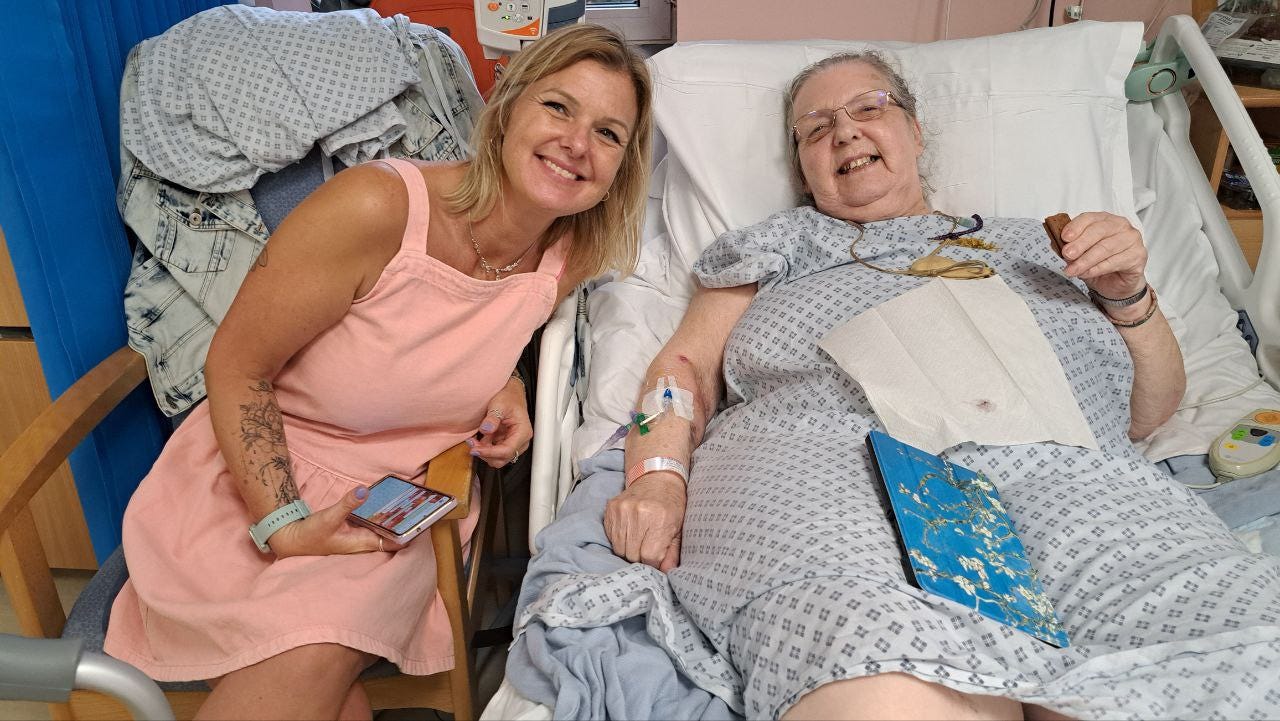
Every day during that first stay — six, maybe eight weeks — I went up to that hospital with a big bag clinking with bottles. Castor oil. Essential oils. Magnesium spray. Moringa tea. Organic smoothies packed with things I’d researched for cancer.
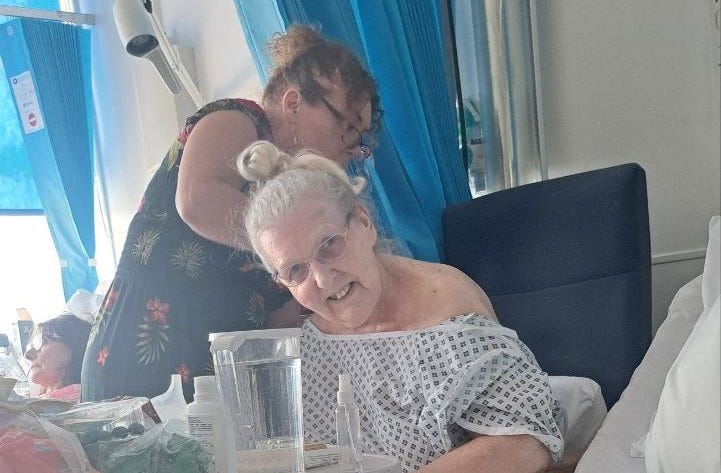
I’d massage every bit I could reach — her face, her arms, her chest, her legs, her hands, the top of her back. All the bits not covered by the hospital gown.
She loved it. The other patients on the ward used to be jealous watching her get an aromatherapy massage while they looked on.
The system wouldn’t support it. But I wasn’t going to do nothing.
“When the system offers very little, families fill the gap. With love. With research. With whatever they can carry in a bag”.
In Article 4 — Inside The System — I write about what happened during Mum’s hospital admissions. The staff. The specific incidents. The complaints we started writing. And the moment her trust in the system broke completely.
If this has resonated with you — whether you’re going through something similar right now, or you’ve already been through it and are still carrying it — you are not alone.
This series is documented, evidenced, and true.
Stay with it. There is a lot more to come.
Thank you for reading our mum’s story. It means more than I can say.
Tags: #callingitout #NHSfailures #cancercare #palliativecare #patientadvocacy #terminalillness #grief #speakingout #unheard #systemfailure #autisticwriter #cancerdiagnosis #DNR #endoflifecare #familycarer #spinalcancer #lungcancer
This is so sad that elderly people are just ignored, and there is no accountability and such lack of care. I am so sorry for the suffering this shocking lack of care inflicted upon your mum, your family and you dear Crystal. So awful that this keeps going on. I think there should be a complete revamp of the medical education on compassion and care. The system needs to be patient centred, not institution centred.