
Inside The System
The longer we stayed inside it, the less safe it felt.

By Crystal Atlantis
This series is based on my personal lived experience and recollections, and drawn from documentation including formal complaints submitted at the time. Names of individual staff members and ward names have been omitted to protect identities. This is not a legal document — it is a human one.
This is Article 4 of an ongoing series. If you haven’t read the previous articles yet, start from the beginning:
Article 1 — They Were Supposed to Care:

Article 2 — Calling It Out:
Article 3 — The Day Everything Changed:
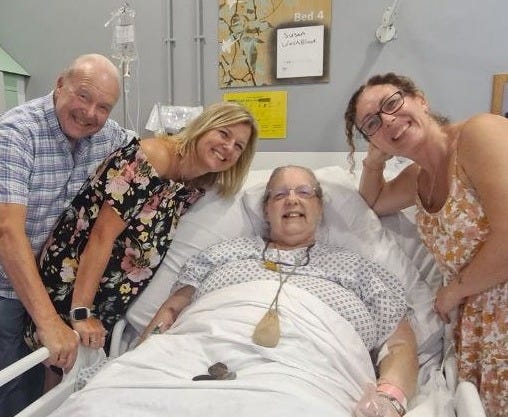
Trying To Keep Her Comfortable
After the diagnosis, life slowly started reorganising itself around Mum’s illness.
At first, we were trying to adapt things so she could still be comfortable. Still get around. Still have some independence. Still have some life.
At one point she had both an armchair and a rise and recline chair, but neither was right for her body.
Everything revolved around the wound.
“So much of our life became trying to adapt ordinary objects around extraordinary pain.”
We were constantly trying to find ways to make the seating and equipment less painful and less damaging for her.
Mum had short legs, which made it difficult for her to sit comfortably in either chair. She couldn’t sit back properly — her legs didn’t reach, which left her perched forward, unable to fully rest.
And on top of that, she had severe oedema.
Her legs and ankles were hugely swollen. They were shiny and stretched with fluid, almost double their normal size.
She said it felt like dragging two tree trunks around.
So sitting wasn’t simple.
Her legs needed to be elevated because of the swelling, but sitting also put pressure on the wound. We were constantly trying to find a way for her body to be supported without making things worse or leaving her unable to get herself forward enough to stand.
So Dad bought foam for both chairs.
We tried medical cushions, foam supports, gel cushions from shops — anything that might reduce the pressure on the wound and make sitting slightly more tolerable.
Looking back, so much of our life became trying to adapt ordinary objects around extraordinary pain.
Wheelchairs became part of life too. Dad bought one so we could try taking her out, and later the hospital provided one as well. But nothing ever seemed to fit properly or feel comfortable. One was too small. Others hurt her.
We only ever managed to take her out a handful of times.
At one point, the hospital made an issue out of Mum using a walking frame because the ward was apparently meant to share one between patients. It upset her enough that Dad went and bought her her own frame and put her name on it.
That was the kind of thing we were constantly doing.
Trying to make uncomfortable things slightly more bearable.
“We kept trying to make uncomfortable things slightly more bearable. That became our lives.”
From The Complaint We Submitted
In the formal complaint we submitted at the time, we explained that Mum had been admitted for a debridement procedure. At that point she was in agony and unable to walk unaided.
We also explained that Mum found it extremely difficult to speak up for herself because of difficult life experiences she had been through.
During those first few days, Mum was not given a buzzer. She was in acute pain throughout the night and unable to move properly. Because she struggled to speak out, she stayed quiet — even though she was in excruciating pain.
The next morning, other patients told staff that Mum had cried all night because of the pain she was in.
The response from one healthcare assistant was aggressive.
Mum was told:
“You don’t ever do that again if you are in pain, you tell us.”
And then:
“Stop being so dramatic.”
Mum was deeply upset by this.
Instead of making her feel safer asking for help, it made her feel frightened to speak up again.
We complained formally afterwards.
And after concerns were raised, the staff member’s behaviour towards Mum changed completely and became much kinder.
We also wrote about a nurse repeatedly insisting Mum get out of bed and sit in a chair — even though Mum was in such severe pain that she could not tolerate sitting upright. This was before the back brace had been fitted, despite the fractures in her spine.
Mum felt unheard, uneasy, and ignored.
Once the seriousness of Mum’s diagnosis became clear, the nurse stopped insisting she sat in the chair.
Because again — it showed that Mum’s pain should have been listened to much sooner.
The First Ward
The first major hospital stay was its own world.
And at first, it was awful.
Bank staff upset Mum as well.
One told her in an aggressive way that she could wash herself, even though she clearly couldn’t. Mum was in pain, frightened, and dependent on people helping her. Being spoken to like that made her cry.
Another night, during personal care, Mum said:
“You’re hurting me. You’re being rough.”
The response was:
“I’m not being rough. You should be thanking me.”
I still can’t understand that.
How can someone be rough with a vulnerable woman, have her tell them they are hurting her, deny it, and then expect her to thank them?
Mum was frightened. She was in pain. She was completely dependent on the person handling her body.
Instead of acknowledging that they were hurting her, Mum was told she should be grateful.
That didn’t feel like care.
It felt neglectful, humiliating, and emotionally abusive.
“You’re hurting me. You’re being rough.” “I’m not being rough. You should be thanking me.”
And Then Something Shifted
After our family complained, things slowly improved.
In the end, we became Mum’s advocates because she couldn’t always speak up for herself.
Staff became gentler. More attentive. More human.
And because Mum ended up being there for such a long time, something unexpected happened.
She settled in.
She made friends with other patients. Staff got to know her. One lovely auxiliary nurse in particular showed her genuine kindness and made her feel seen and special.
And Mum — Sue, who had spent much of her life feeling invisible — started to become the matriarch of the ward.
The queen of it, really.
She actually enjoyed parts of being there.
That was both beautiful and heartbreaking to witness.
Because underneath everything, what Mum had always wanted was simple.
To feel cared for. To feel loved. To feel valued. To feel seen.
Most people knew Mum as Sue
She had been Susan as a child — but she always preferred Sue. That was who she became. The woman she chose to be.
But during the illness, the carers called her Susan. The nurses who came to the house called her Susan. The hospitals, the forms, the official systems — all Susan.
And somehow, the more unwell she became, the more Sue got eroded away.
Until she became Susan again.
I’ve thought about that a lot since.
Because Sue was the everyday person we loved. The familiar version of her. Our Mum, a good friend, a woman who laughed at silly things and had a dirty sense of humour, which she prided herself on.
And Susan was the version being processed through systems, paperwork, wards, and procedures.
It’s strange how illness can even take back the name you chose for yourself.
“Sue was the everyday person we loved. Susan was the version being processed through systems, paperwork, wards, and procedures.”
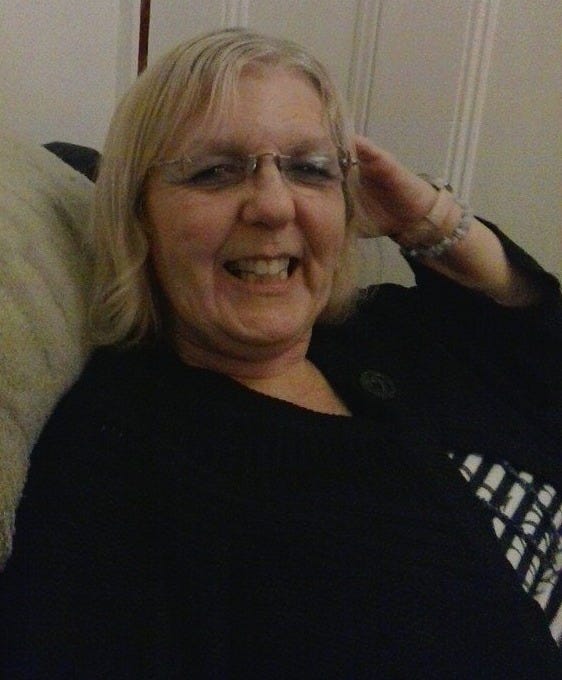
She was stronger than we realised
One thing that surprised all of us was how strong and positive Mum became through so much of her illness.
Before the cancer, Mum could be quite negative at times. Angry at life in the way people sometimes become after carrying pain and disappointment for a long time.
But after the diagnosis, something changed in her.
She made a conscious decision that she was going to stay positive.
And she did.
She kept saying:
“Onwards and upwards.”
Or:
“I’m staying positive.”
And she genuinely was.
She showed a level of strength none of us fully realised she had in her.
For most of the illness, she hardly complained at all considering what she was living through. The pain. The wound. The loss of mobility. The fear. The indignity of so many situations she was forced into.
And yet she kept going.
Kept laughing.
Kept being loving.
In some ways, Mum became happier during her illness than she had been for much of her life.
That sounds strange to say. But emotionally, something softened in her.
She became more open. More loving. More able to receive care and connection. Stronger.
And honestly, by the end, there were moments where she seemed more at peace in dying than she had been in living.
Not because dying was easy.
It wasn’t.
She didn’t want to die.
But because somewhere along the way, underneath all the illness and fear and pain, she seemed to find something none of us had seen in her before.
Towards the very end, when everything had become relentless, she finally said:
“I’m sick of this. I just want it to stop.”
And honestly, by that point, who wouldn’t?
But for most of the journey, she carried herself with a strength and positivity that completely changed the way we saw her.
“Onwards and upwards.”
The First Care Package
After that first hospital stay, Mum came home with the first care package in place.
At first, they weren’t awful.
But they weren’t good either.
The care felt inconsistent. Detached.
One day Mum was screaming in pain and a carer stood there making notes while Mum cried. She held Mum’s hand briefly, patted it, said:
“There, there.”
And then left. No meaningful help. No escalation. No action. Just notes.
That was the day Mum went back into hospital.
When Mum was eventually discharged again, the hospital’s own discharge care plan clearly documented that she required full physical assistance with her medication on every single visit. That information was sent directly to the care agency. They had it from the start.
And yet on the very second visit after discharge, the medication still wasn’t given.
We had to administer it ourselves.
That is yet another failing. Not by one person. Not by one bad day. But by a system that documented what Mum needed and then did nothing to make sure it happened.
The Second Time In Hospital
The second time Mum went back into hospital, her legs were severely swollen with oedema. Huge, shiny, red, and hot. She was also in excruciating pain. 111 advised her to go to A&E.
By then, they knew Mum had metastatic cancer in her spine. They knew she had fractures in her back. They knew she had an open wound, an extensive sacral ulcer. They knew she had severe oedema. And they knew she had an open wound.
They knew she should not have been left sitting upright for so long.
And yet she was left in A&E for over 15 hours without a proper pressure relief cushion.
No proper cushion. No leg elevation. No real help.
Just left there.
As a direct result of sitting on a hard chair without proper pressure relief for that long, the sacral ulcer became infected. The infection reached the bone — osteomyelitis.
Before this, the wound had been healing. A vacuum dressing had been ordered by the district nurse, and there had been hope that it could keep improving.
But after being left sitting like that, everything changed.
At one point the wound dressing was also done incorrectly — the wrong type of dressing was used and it adhered to the wound. When it had to be removed, it was extremely painful and had to be soaked in saline before it could come away.
After that, the wound became worse again.
Sometimes harm happened through things being done badly.
From The Complaint: The Second Hospital Admission
During the second inpatient hospital stay, Mum was not washed or helped to brush her teeth for four days, despite a clearly visible sign above her bed stating she needed assistance.
As we explained in the complaint, Mum struggled to ask for help and often stayed quiet instead.
After our family complained, a doctor agreed this was unacceptable.
Originally, Mum was placed in a side ward. At 1am, she was moved because staff said radiation from a room opposite made it unsafe for her to remain there.
She was moved into a different area with another patient and felt happier there.
Several days later, she was moved back into the original side ward again.
When we questioned staff about the radiation concern, we were told that it was not the case and that the room was safe. Mum was made to feel like the concern had never existed, and she imagined it.
Then, around 45 minutes later, Mum was suddenly informed she was being moved again because the room was needed.
Mum cried when she was told she was moving.
By then, she had been moved around repeatedly and felt deeply unsettled and insecure.
There had also been a special arrangement allowing Dad to visit outside normal visiting hours when Mum became frightened or distressed during the night.
We were told that the arrangement would continue to their sister ward, where Mum was being taken to, because the wards worked in the same way.
It did not.
We also had to repeatedly chase for basic care.
When we asked for Mum to be helped with washing, a nurse rolled her eyes before calling a student nurse to assist.
To wash Mum properly, her antibiotic line had to be disconnected.
Afterwards, the antibiotics were never reconnected.
This mattered because the antibiotics were not casual medication. They were being given for the serious bone infection of osteomyelitis mum had, and we had been told they needed to be given on the dot.
So when the line was disconnected for washing and not reconnected afterwards, it was frightening.
When we raised concerns, the nurse initially did not believe us. Then she checked and realised the antibiotics had indeed not been reconnected.
Soon afterwards, the line had to be changed again because bubbles had appeared in it.
We also asked about the SR1 form Mum needed and were told in a flipant way:
“We’re on skeleton staff.”
There were repeated problems with cannulas during this admission, too.
Several cannulas were fitted incorrectly and ended up tissuing.
Mum’s hand swelled so badly that fluid was squirting out from her skin. It took many days for the swelling to go down, and it was extremely painful for her.
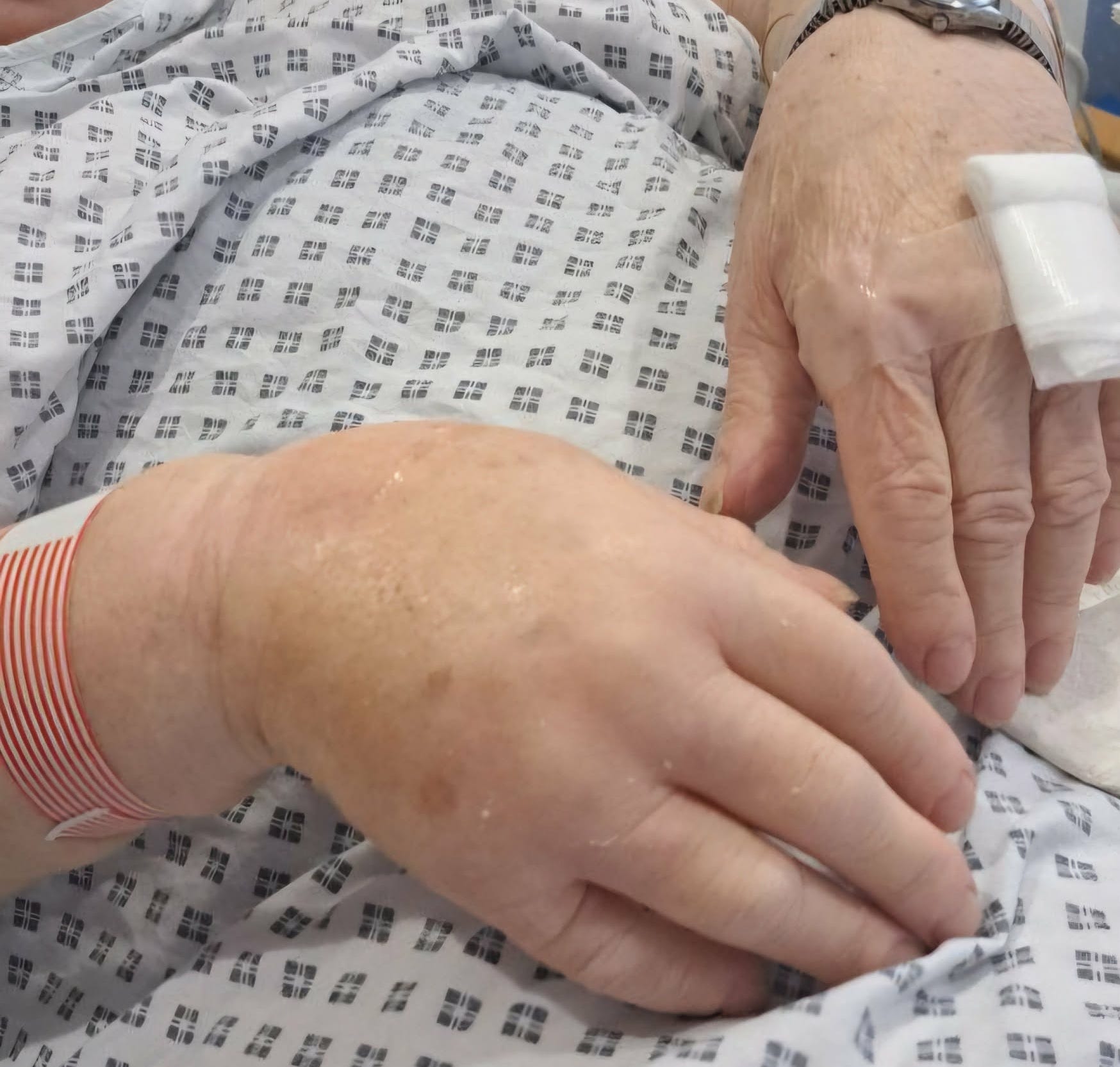
Another cannula caused a red, hard lump to develop on her arm. It was hot to the touch and around the size of a tennis ball.
Both times, the cannulas had to be removed and refitted.
At one point, Mum also had a CT scan. A porter arrived with an old wheelchair and became irritated when Mum could not sit in it properly because he had not been informed about the fractures in her spine or why she physically could not tolerate sitting upright.
Dad had to repeatedly explain her condition again and again.
That became another exhausting pattern throughout all of this — constantly having to re-explain how ill Mum was because information never seemed to properly follow her through the system.
On another occasion, Mum’s wound was left undressed and weeping.
When Dad questioned this, the focus became about visiting hours rather than the fact that the wound had still not been redressed.
At the end of the complaint, we wrote that Mum had:
been diagnosed with a terminal illness
been refused treatment because she did not meet the criteria
Received conflicting information from different doctors, which caused her distress.
and experienced what felt like a total lack of compassion, attentiveness and dignity throughout much of her care.
We asked for:
an explanation as to why Mum had been treated so poorly
improvements to how medical records and special arrangements were communicated
better access to appropriate equipment
training around dignity, compassion and humane care
and an apology.
But more than anything, we wanted people to understand that Mum was a human being.
Not a problem to manage. Not a bed to move. Not a wound. Not a task.
A human being.
“Not a wound. Not a task…… Mum was a human being.”
After the second hospital admission, we asked for different carers.
A new care package was put in place.
And that is where Article 5 picks up.
The Doctor
On one of those days, a doctor came to Mum’s bedside on the ward she found herself on at the time.
He didn’t pull the curtain around. He didn’t lower his voice.
He swept his arms towards her — gesturing at her lying in the bed — and said, loudly, where other patients could hear:
“This is as good as it gets for you, being bed-bound. Your wound will never heal, and your bone infection will never heal.”
No gentleness. No privacy. No compassion.
Shocking words - imposed on a frightened, seriously ill woman who was already struggling to cope.
The other patients were shocked and troubled by his callousness.
And Mum was not the only one he did this to.
She Was Determined
In the beginning, Mum was determined to get better.
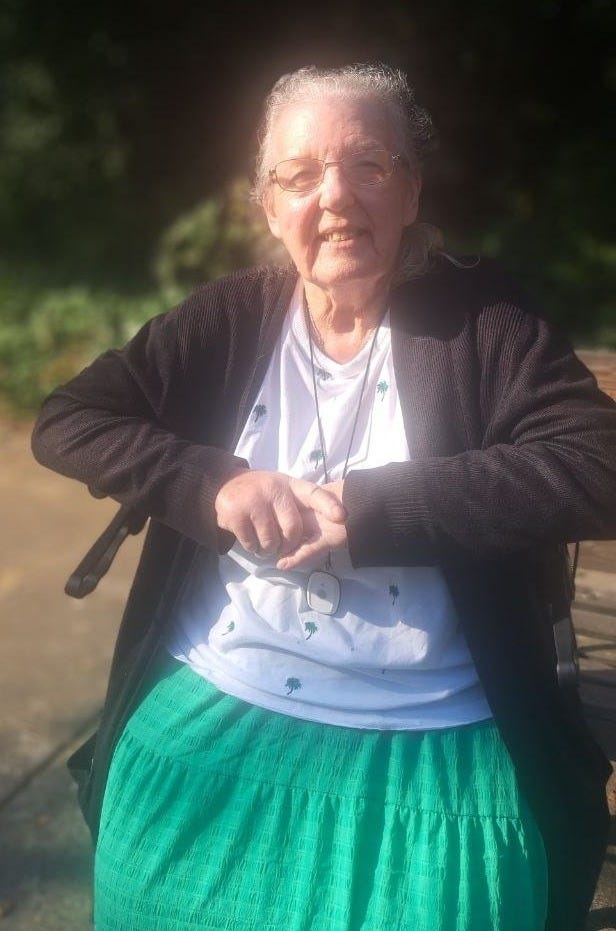
When she was still more mobile, she used to walk around the courtyard and parking area outside her flat with her Zimmer frame. There was a bench where she could stop and sit for a while, just to get some fresh air.
It mattered to her.
She was trying. She was pushing herself. She wanted movement, independence, and some kind of normal life back.
That is one of the hardest parts to carry now.
Mum was doing everything she could. But so much of what happened to her during her illness was not caused by her giving up, or by the cancer alone.
It was caused by systematic failures around her.
By things not being done properly. By pain not being listened to. By pressure relief not being provided. By basic care being missed. By negligence that kept taking more and more from her body until the life she was fighting for became smaller and smaller.
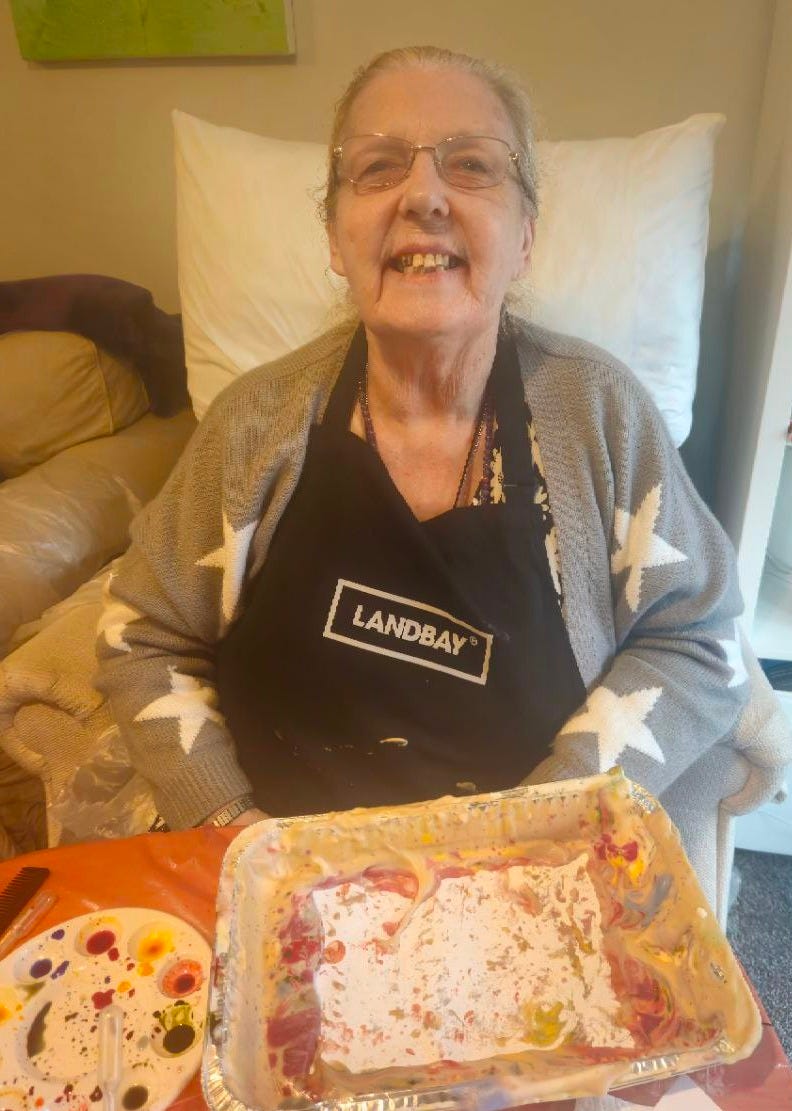
The Marbling Afternoon
One afternoon that has stayed with me — me, Kerry and Mum.
Mum loved art and creating, so I came up with the idea of marbling with shaving foam.
I’d spent days collecting plants and natural materials and cooking them down to make natural paints — I didn’t want Mum using chemicals. We covered the entire front room in pink plastic bags. Tables, floors, furniture.
It was cramped and chaotic. But we made it work.
Mum sat in her rise and recline chair while we did marbling together using shaving foam, food colouring and natural paints.
She loved it.
You could see how tired and poorly she was by then. But she was there.
Present.
Making something.
The carers came in during it and were unsure at first, but eventually they stood watching and seemed to enjoy it too.
What The Hospital Admitted
When we received the formal response to our complaint, the hospital acknowledged that the Emergency Department had not effectively managed Mum’s pressure area care during her long wait.
They apologised for the doctor’s behaviour on Estuary Ward — the one who told Mum this was as good as it gets.
They acknowledged the nurse rolling her eyes was unacceptable.
They apologised that the visiting arrangement for Dad wasn’t continued.
And they confirmed that the discharge care plan clearly documented Mum required full physical assistance with medication on every visit — meaning the care agency had that information from the start.
They wrote letters. They used the right words.
But the harm had already been done.
“They wrote letters. They used the right words. But the harm had already been done.”
In Article 5 — I write about the care agencies, the fall, the medication concerns, inaccessible records, safeguarding issues, and the growing feeling that we were fighting to keep Mum safe inside her own home.
If this has resonated with you — whether you are living through something similar now or carrying it long afterwards — you are not alone.
This series is documented and true.
Stay with it. There is a lot more to come.
Thank you for reading Mum’s story. It means more than I can say.
Tags: #callingitout #NHSfailures #cancercare #palliativecare #patientadvocacy #terminalillness #grief #speakingout #unheard #systemfailure #autisticwriter #hospitalcare #carerexperiences #endoflifecare #familycarer #sacralulcer #oedema #patientdignity